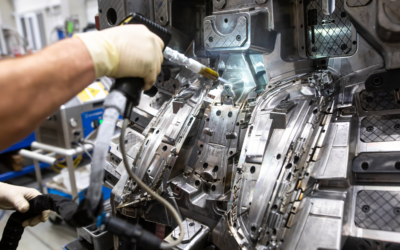

Ask a plant manager what limits their output and you’ll usually hear about labor, machine availability, or material. Ask again in the middle of an unplanned die change and the answer gets more specific: they’re limited by how many working tools they have, and how long it takes to get another one.
That constraint has tightened noticeably over the past two years, and it’s changed what surface treatment is actually worth. The conversation used to be about maintenance budgets. It’s increasingly about production capacity, and those are very different conversations to have with a CFO.
What changed
Three things have converged.
Tooling lead times are the long pole in every new program. Mold and die development consistently runs longer than any other stage of bringing a part to production, and when a tool fails unexpectedly, that timeline doesn’t shrink because you need it urgently. A replacement die is not a purchase you can expedite your way out of. Whatever your lead time is, that’s how long a failed tool costs you, minus whatever spares you happen to be holding.
Parts are getting harder on tools. Automotive electrification has pushed die casters toward larger structural components with thinner walls, which means higher injection velocities and higher pressures to fill them. Magnesium and optimized aluminum alloys are showing up in applications that used to be steel. On the plastics side, glass and mineral filled resins keep gaining share for the same lightweighting reasons. Every one of those trends increases the wear, erosion, and thermal loading your tooling absorbs per cycle. A die running a 2026 structural casting is not doing the same job a die was doing ten years ago, even at the same shot count.
Domestic volume is coming back. Reshoring and nearshoring have brought programs back to North American plants, which is good news that arrives as pressure on existing capacity. More parts through the same tooling, often on compressed timelines.
Put those together and the tool sitting in your press stopped being a consumable and started being a bottleneck asset.
Where this actually shows up in the numbers
Most operations track tool wear as a maintenance line item. That undercounts it in three specific ways.
Unplanned downtime is not the same as planned downtime. A scheduled tool change is a known cost you’ve already staffed and sequenced around. A die that solders badly on a Tuesday afternoon is lost production, disrupted scheduling, expedited freight to the customer, and sometimes a conversation about missed delivery. The cost of the tool itself is often the smallest part of that.
Spare tooling ties up capital and floor space. The practical answer to long lead times is holding spares, and that works, but it’s expensive. Every spare die represents cash sitting on a rack against a failure that hasn’t happened yet. Extending the service life of the tools in production reduces how deep that bench has to be, and that capital goes somewhere more useful.
Quality drifts before a tool fails outright. Tools rarely fail cleanly. They degrade. Surface finish deteriorates, flash increases, dimensions creep toward the edge of tolerance, and scrap rates climb quietly for weeks before anyone declares the tool done. That period of degraded output is real cost, and it almost never gets attributed to tool wear because it doesn’t come with a work order.
When you add those three to the replacement cost, the value of doubling or tripling tool life stops looking like a maintenance saving and starts looking like added capacity you didn’t have to buy a press for.
The window that matters most
Here’s the part that gets missed. The highest-return moment to treat a tool is before it ever runs production, not after it starts failing.
A new die that goes into service untreated begins accumulating damage on shot one. Soldering starts building on the surface, thermal cycling starts working on the steel, and gate erosion begins. Treating that same tool before first production means it enters service with the surface it needs to resist those mechanisms from the beginning.
Treating a tool after it has already heat checked is a different proposition. Surface treatment can extend the remaining life of a tool that’s showing early wear, and often it’s worth doing, but you’re managing existing damage rather than preventing it. The cracks that are already there don’t go away.
The practical implication is worth building into how tooling gets procured: surface treatment should be specified as part of new tool qualification, alongside the steel grade and the hardness spec, rather than considered later when the tool starts giving trouble. It adds a short step to a program that is already measured in months, and it changes the entire service life of the asset.
For tools already in production
If your existing tooling wasn’t treated at build, you’re not out of options. Most tools in service can be treated during a scheduled maintenance window, and diffusion processes like DYNA-BLUE run below the tempering temperature of common tool steels, so there’s no distortion and no need to re-harden. Tools come back dimensionally where they left.
That also means refurbished tooling can be treated after weld repair, which matters if you’re already extending the life of dies through repair cycles. DYNA-BLUE PLUS exists specifically for complex and refurbished tools where surface finish and longevity both matter.
Two things determine whether it’s worth doing on a given tool. First, how much life is realistically left in the base metal. A die with extensive heat checking through the cavity is at the end of its road regardless of what you put on the surface. Second, how much of your remaining program runs on that tool. Treating a die with two years of production ahead of it is straightforward math. Treating one with three months left generally isn’t.
The question worth asking this quarter
Look at your tooling list and identify which tools you cannot afford to lose on short notice. Not the ones that wear fastest, the ones whose failure would actually stop a program, because those are two different lists and the second one is shorter.
For each of those, ask how long a replacement would take, whether you have a spare, and what the surface currently is. That exercise usually surfaces one or two tools that represent far more risk than anyone had quantified.
Those are the tools worth talking about first.
Let’s look at your list
Dynamic treats tooling for die casting, injection and compression molding, forging and hot forming, hot and cold stamping, oil and gas, and aerospace and military applications. Our processes run from diffusion treatments like DYNA-BLUE and DYNA-BRITE through DYNA-COAT™ hard coatings, the DYNA-MAX duplex process, and 10 bar vacuum hardening, all in house. That range means we’re not steering you toward one process because it’s the only one we run.
Send us your highest-risk tools, or the failed one you’re holding onto because you haven’t decided what to do with it yet. We’ll tell you what’s worth treating, what isn’t, and what to specify on the next one.
Schedule a Call, or run your own numbers first with our savings calculator.